Kontenery magazynowe na substancje niebezpieczne
Hazardous substance storage containers
A storage container instead of a pallet of solvent against the factory wall
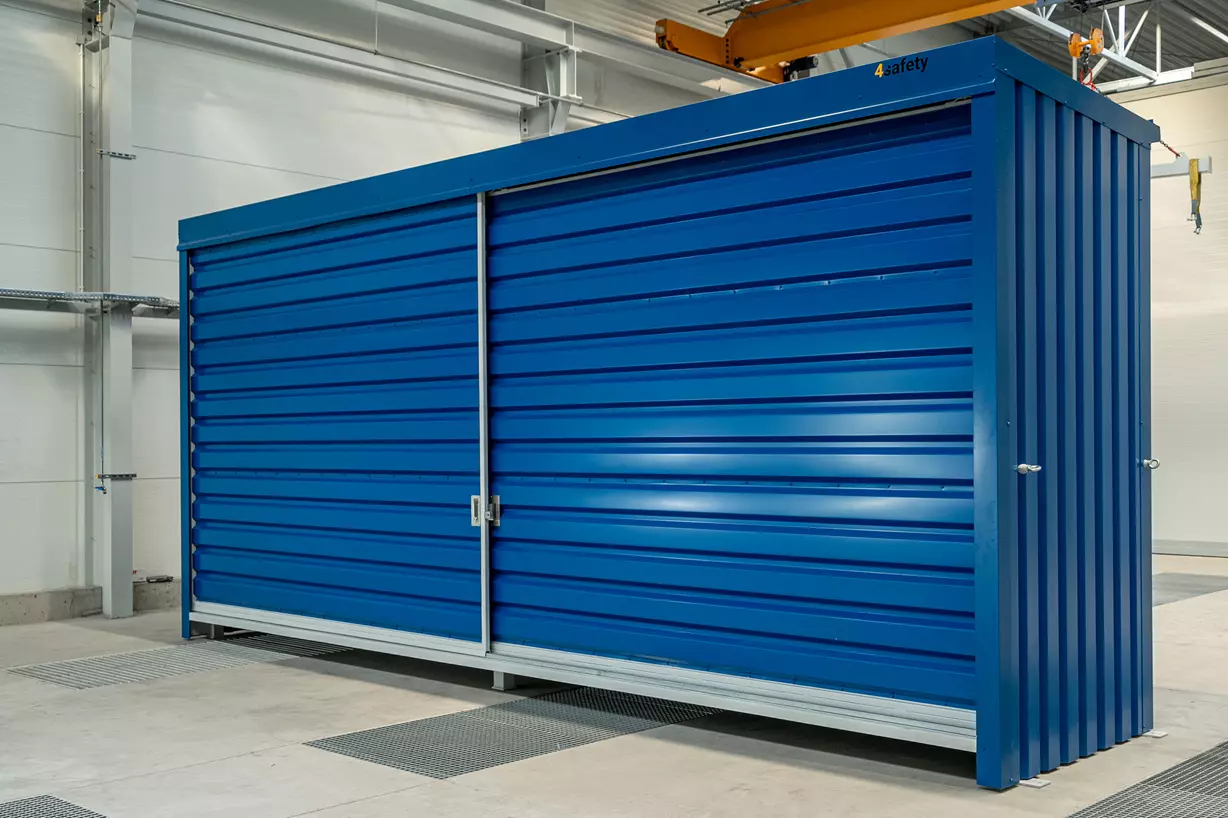
A hazardous substance storage container moves chemicals, oils, paints and waste out of the production building. People work away from the stock, and a fire or leak stays in one place built to contain it.
In many plants it looks like this: drums stand in a corner of the hall, an IBC of waste waits under a shelter, and more than a day's supply is kept next to the line. Everything works until the first inspection, the insurer's visit or the first spill.
- Flammable substances inside the building raise the risk for the whole hall and everyone working in it.
- A leak without a spill sump ends up on the floor, in the drains or in the ground.
- No dedicated storage area is a typical finding after an H&S, fire safety or environmental audit.
- Extending the hall for chemical storage takes a long time and requires permits.
Custom design
We don't pick a container from a catalogue. We design it around your substances.
Design, manufacture and installation of a container built for your substances. Two plants storing the same IBCs may need completely different containers. That is why we start with a conversation with an adviser and a site visit, and only then make the drawing.
What we look at before the drawing is made
Every container is built to order. Dimensions, number of levels, insulation and equipment follow from your process.
- Safety data sheet, so we know whether insulation is enough or whether you need fire resistance or an ATEX version.
- Quantities and packaging: drums, IBCs, euro pallets. Plus spare capacity for growth.
- Active or passive storage. If you decant inside, we design a workstation. If you only store, a ramp for the forklift.
- Site conditions: sun exposure, winter, the temperature the substance requires.
- Ground and access, so delivery and placement go without surprises.

An adviser comes to your plant
They check the placement area, forklift access routes and how you work with the substances. Based on that, they propose the layout and equipment.
One person from the first call to handover
We don't pass you between departments. Your adviser knows the project and answers questions from H&S, purchasing and maintenance.
Polish manufacturing
Containers are built in Poland, supervised by our engineers and designers. It is easier to change the design and keep an eye on the details.

Choosing a container
Insulated, fire-rated or two-level? The container follows what you store
We match chemical storage containers to the safety data sheet and the quantity of substances. Below is a starting point for a conversation with an adviser. The final build is agreed after the site survey.
| What you store | Build | See in the shop |
|---|---|---|
| Substances sensitive to frost and heat: paints, adhesives, oils | Insulated container with PIR or mineral wool core sandwich panels. Optional heating and air conditioning. | Insulated containers |
| Flammable liquids, flammable waste | Fire-rated container, class REI 60 or REI 120, i.e. with a defined fire resistance time. | Fire-rated containers |
| Substances whose vapours may explode | ATEX version with explosion-proof installations. The Ex zone stays inside the container and does not extend into your plant. | All containers |
| Many IBCs and pallets, little space on site | Two-level container, e.g. for 4 or 6 IBCs. Spill sumps on the upper level too. | Two-level containers |
| Single IBCs or drums next to a workstation | Single-level container, insulated or non-insulated. | Single-level containers |
| Lithium-ion cells and batteries | Fire-rated container with detection and emergency ventilation. | Li-ion battery containers |
Equipment we fit to the project. A floor spill sump is standard in every one of our hazardous substance containers.
Take a closer look
What a 4safety container looks like inside
Projects and references
What plants using our storage containers say
Electronics, shipbuilding, chemicals, metal processing. The excerpts come from reference letters we received after handover, translated from Polish.
Comprehensive advice – 4safety's experts helped us at the stage of choosing the solution, proposing materials and a container layout perfectly suited to the specific substances stored.
The company showed real expertise in its individual approach to our needs. (…) with non-standard work, great flexibility and ingenuity in achieving the set goals matter.
The company's staff showed great commitment, expertise and flexibility in their individual approach to the needs of our plant.
The store was designed and built to our needs, professionally and with due care.
The company showed expertise in its individual approach to our needs and reliability in matching the right solution.
These are a few of more than 150 projects. Your adviser will show you projects similar to yours, from the same industry or for the same substances.
Compliance and quality
A container that passes the audit, not just the handover
We match the fire resistance class, explosion protection and equipment to the substances that will be stored. Documentation is prepared together with the delivery.
The time for which the structure keeps its load-bearing capacity, integrity and insulation in a fire.
Installations that prevent ignition. The Ex zone is limited to the inside of the container.
A leak stays inside the container and does not reach the ground or the drains.
PIR and mineral wool sandwich panels from proven suppliers.
Quality shows in the details
Welds, flashings, door seals, sump slope. A container stands outdoors for years, so we watch the things you won't see on a visualisation. In its reference letter, Universal Scientific Industrial Poland noted that the container is built "with attention to detail, solidly".
Less paperwork than extending the hall
In most cases a storage container does not need a building permit. It can later be moved, fitted with more equipment or relocated when the plant is reorganised.
How we work
From the first call to the container standing on your site
One team runs the whole project. As one client put it: "from preparing the documentation, through loading, to the final placement of the container".
- Talk to an adviserSubstances, quantities, packaging and timing.
- Site surveySite, ground, access, how you handle the chemicals.
- Design and quoteDrawing, equipment, a clear scope in one quote.
- ManufactureBuilt to order according to the design.
- Delivery and placementDelivery to site, placement and levelling.
- Handover and serviceDocumentation, instruction, future upgrades.

Who it's for
Everyone in the plant asks about something different. We answer them all.
A dedicated area and documents in order
Substances outside the hall, a spill sump, a fire resistance class matched to the safety data sheet. Fewer audit findings and a stronger case when you talk to the insurer.
Stock close to the line without taking up the hall
The container stands against the building wall. A day's supply stays at the workstation, the rest waits next door. Ramp and interior layout designed for your forklift.
One supplier, one scope
Design, manufacture, equipment, delivery and placement in one quote. A Polish manufacturer, so changes, parts and service are easier.
Frequently asked questions about storage containers
Does a container need a building permit?
In most cases, no. Requirements depend on the location and how the container is founded, so we check this with you at the design stage.
How do I prepare the site for a container?
The ground must be level and hardened. Heavier containers, counted with full containers inside, sometimes need a foundation. Your adviser will assess this during the site survey.
When do I need a fire-rated container, and when is an insulated one enough?
The safety data sheet decides. Flammable substances require a fire-rated container, e.g. REI 60 or REI 120. Insulation protects the contents from heat and frost, but it does not replace fire resistance.
Can the container be ATEX-rated?
Yes. For substances whose vapours can form an explosive atmosphere, we fit the container with explosion-proof installations. The Ex zone stays inside it.
How many IBCs or pallets will a container hold?
As many as we design it for. The shop offers ready configurations, e.g. for 1, 2, 4 or 6 IBCs. For larger needs we design a two-level container or several modules.
Can the container be moved or upgraded later?
Yes. That is one of its advantages over extending the building. You can move the container when the plant is reorganised and add equipment, such as shelving, ventilation or air conditioning, when the need arises.
Show us your site. We'll design the storage container.
Tell us what you want to store and in what quantity. A regional adviser will contact you and arrange a site survey.