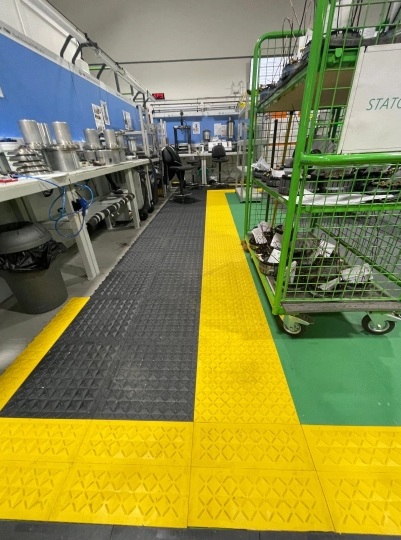
Our regional advisors will help you choose a product tailored to your needs | We provide installation, service, and inspections! | Only trusted suppliers!
Shopping cart (0)
- Products
-
Services
- Spill response training
- Lockout Tagout implementation
- Inspection and maintenance of safety cabinets
- Lockout Tagout training
- Office equipment and layout
- Selection and installation of industrial matting
- Delivery and installation of flexible barriers
- Marking of traffic routes
- Traffic risk assessment audit
- ATEX technical audit
- Selection and installation of industrial safety fencing
- Catalog
- Case study
- Blog
- About us
- Contact
Industrial anti-fatigue mat – What is it?
Anti-fatigue mats are an increasingly popular solution for safeguarding employees’ health and wellbeing. If your team carries out tasks whilst standing, it is worth taking steps to reduce their fatigue, thereby maximising their efficiency, wellbeing and safety.
Choosing an anti-fatigue mat is a process that should be based on a few specific criteria. Below you’ll find a practical guide to help you make a decision tailored to the conditions in your hall.
Contents:
- What is an anti-fatigue mat and how does it affect an employee’s body?
- Construction and materials – What is an industrial mat made of?
- Standards and certifications worth knowing when choosing a mat
- Types of anti-fatigue mats for halls and warehouses: how to choose the right mat for your workstation
What is an anti-fatigue mat and how does it affect an employee’s body?
An anti-fatigue mat is a workstation mat designed for employees who spend their shifts standing. Examples include, amongst others,
- production line operators,
- editors,
- quality control staff,
- packaging staff
- bartenders,
- staff at retail outlets (grocery shops, pharmacies, etc.).
Unlike rubber flooring or industrial carpeting, an anti-fatigue mat has a specially designed internal structure. Its purpose is to actively relieve pressure on the joints, spine and circulatory system during prolonged standing on a hard floor.
Why do industrial anti-fatigue mats work?
When an employee stands on a hard, rigid surface (e.g. concrete, epoxy resin or industrial tiles), the surface exerts a reaction force equal to the body’s weight, which is not dispersed. Consequently, the entire weight is borne by the feet, ankles, knees, hips and the lumbar region of the spine. With an 8-hour working day, this results in increasing muscle fatigue, pain in the feet and back, and, in the long term, increases the risk of chronic musculoskeletal disorders.
The anti-fatigue mat reduces the effects of pressure thanks to its flexible design, which gives way under the pressure of the foot and partially absorbs the energy. In this way, it forces the body to make a constant, microscopic stabilising effort. This means that the calf and foot muscles are working continuously, albeit to a minimal extent. The effect of this micro-movement is to improve microcirculation in the lower limbs, which reduces the sensation of ‘heavy legs’, swelling and tingling.
At 4safety, we focus on workstation mats with a core density and thickness selected to ensure that the mat both absorbs impact and returns energy with every step. This ensures that the worker does not sink into the mat as if it were a soft mattress – which would cause additional strain on the stabilising muscles – but instead receives controlled support tailored to their body weight and the nature of their work.
The benefits of installing anti-fatigue mats in a production hall or warehouse go beyond employee comfort. Companies that invest in workstation equipment report lower sickness absence due to back and joint problems, fewer injuries resulting from fatigue and loss of concentration, and a measurable increase in productivity at workstations requiring precision – for example, in assembly or quality control.
Anti-fatigue mats are increasingly regarded as a standard feature of standing workstations, on a par with protective clothing and work area signage. So make the most of the opportunities awaiting you at 4safety.
Construction and materials – What is an industrial mat made of?
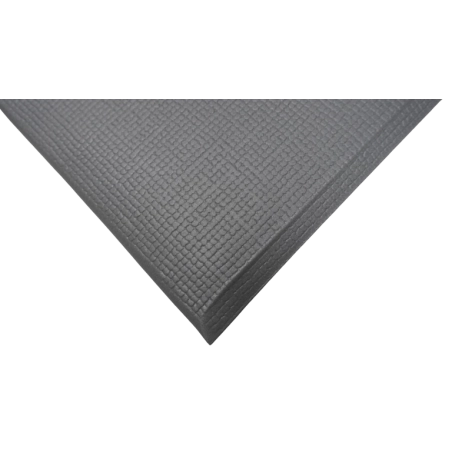
The effectiveness of an anti-fatigue mat stems from its multi-layered construction. Each layer serves a different purpose. A standard industrial mat consists of three basic components: the top (wear) layer, the shock-absorbing core, and the non-slip backing, which stabilises the whole mat on the floor.
The top layer is the part with which the worker comes into direct contact. It must combine mechanical resistance with adequate grip. Depending on the purpose of the workstation, the following are most commonly used here:
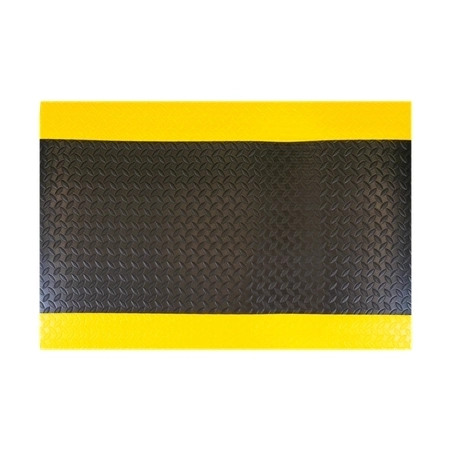
- PVC (vinyl) – a versatile, relatively lightweight material that performs well in dry areas with moderate footfall. It is easy to clean and available in a range of surface textures (grooved, pebble-effect, diamond-patterned).
- Nitrile rubber – more resistant to oils, greases, fuels and solvents. This makes it ideal for use in mechanical workshops, at machining stations and in areas where there is contact with chemicals.
- Polyurethane (PU) – a material with high resistance to punctures, tears and abrasion, used in situations where sharp metal shavings, debris or tools may come into contact with the mat.
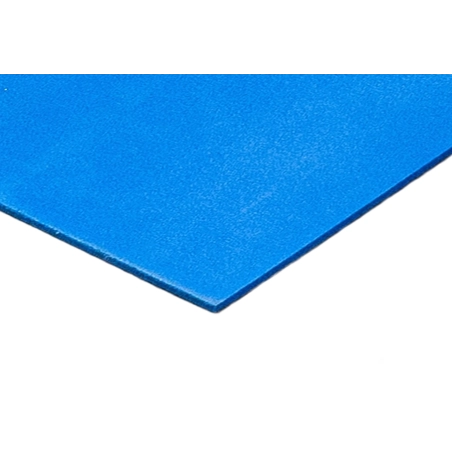
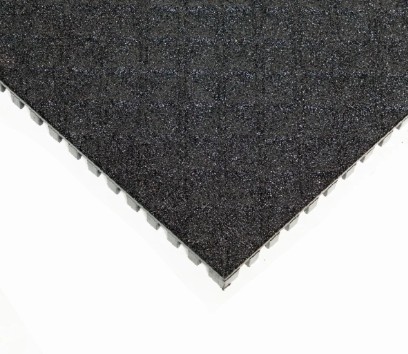
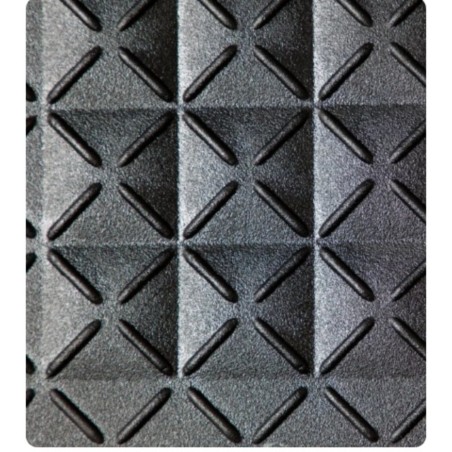
The shock-absorbing core is the heart of the anti-fatigue mat. It is responsible for the springy feel. It is most commonly made from closed-cell vinyl foam (e.g. Nitricell) or PVC foam, although mats with enhanced ergonomic properties may also feature a system of air domes beneath the surface. Their purpose is to more effectively encourage micro-movement of the foot with every step.
The thickness of industrial anti-fatigue mats ranges from 9 to 19 mm. Thinner versions are used where stability is important when pallet trucks and rack-mounted trolleys are in use. Thicker versions, on the other hand, are used at workstations where staff spend their shift standing still.
The underside of the mat is usually made of dense vinyl foam or rubber with enhanced grip on the floor. Its purpose is to prevent the mat from sliding whilst in use.
Bevelled (angled) edges eliminate the risk of tripping over the edge of the mat when entering and leaving the work area. Good design practice dictates that bevelling is only required on those edges of the mat that the worker actually walks over. There is no point in bevelling the sides that are adjacent to, for example, a machine or a wall.
Please note! Pay attention to the composition of the materials used to make the anti-fatigue mat. An increasing number of manufacturers are offering mats that are free from phthalates (DOP-free), heavy metals and silicone. This is important both for the health of employees and for compliance with the environmental standards of many manufacturing companies. The choice of surface material, core density and mat thickness should be based on the characteristics of the workstation.
Standards and certifications worth knowing when choosing a mat
When choosing an anti-fatigue mat for a production hall or warehouse, you should first and foremost consider its slip resistance rating. Technical standards allow you to objectively compare mats from different manufacturers and select a product suited to the actual conditions in the hall.
The primary standard used in the assessment of mats and workplace floor coverings is DIN 51130. The test is carried out on an inclined surface. Engine oil is applied to the test specimen at a rate of 200 ml/m², and a tester wearing certified safety footwear walks across it whilst the surface is gradually raised. The angle of inclination at which the tester loses traction and begins to slip determines the assigned class – ranging from R9 (lowest slip resistance, angle 3–10°) to R13 (highest, above 35°).
For industrial halls, the market standard is class R10 (slope of 10–19°). However, in areas where there is an increased risk of oil, grease or chemical spills, it is worth considering class R11 and above.
Important! DIN 51130 should not be confused with DIN 51097. The latter standard applies to surfaces used barefoot in high-humidity environments, such as swimming pools, showers and changing rooms.
The classification of fire behaviour in accordance with EN 13501-1 is also important. Mats intended for areas adjacent to welding stations, heat treatment areas or heat sources should have a certified classification, e.g. Dfl-s1. This indicates limited flame spread and low smoke emission. Please note that in the event of a fire safety inspection, the absence of documentation confirming the relevant classification may be a problem.
ESD mats, compliant with the EN 61340-5-1 standard, used at assembly and service workstations for electronics sensitive to electrostatic discharge. For the electrostatic discharge (ESD) dissipation system to function correctly, both the floor mat and the mat placed on the worktop must be safe. Using only one of them does not complete the earthing circuit and does not provide full antistatic protection.
Types of anti-fatigue mats for halls and warehouses: how to choose the right mat for your workstation
Choosing the right anti-fatigue mat involves matching the type of mat to the nature of the working environment and how the workstation is used. Below are the key categories you should familiarise yourself with before making a purchase.
Classification by working environment
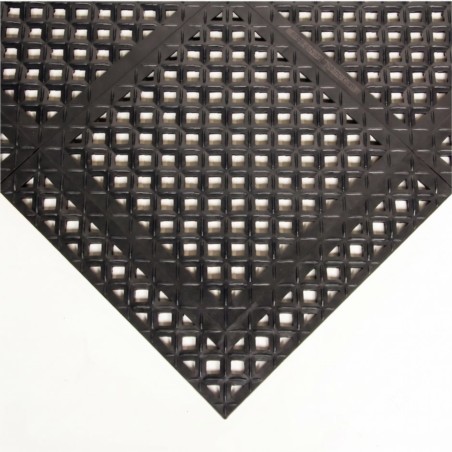
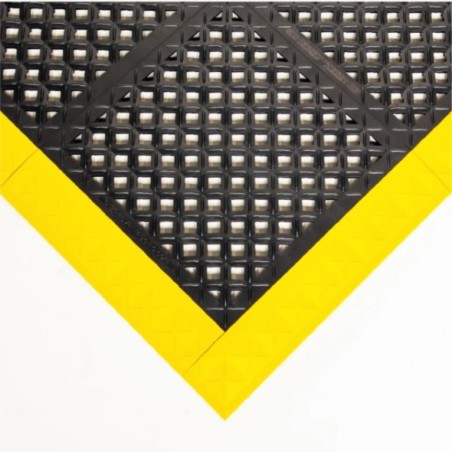
W strefach suchych i o umiarkowanym natężeniu ruchu, dobrze sprawdzają się maty antyzmęczeniowe piankowe i winylowe. Są one lżejsze, łatwe w utrzymaniu czystości i oferują wysoki komfort przy niskich kosztach. Zupełnie inne wymagania stawiają strefy mokre i przemysłowe, gdzie na podłodze mogą pojawiać się oleje, smary czy środki chemiczne. W takich przypadkach standardem są maty antyzmęczeniowe gumowe lub nitrylowe, często wyposażone w otwory drenażowe umożliwiające odprowadzenie rozlanej cieczy spod stóp pracownika. Zwiększa to bezpieczeństwo antypoślizgowe.
Classification by product form
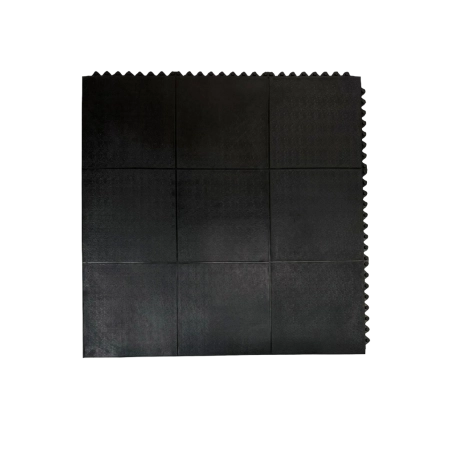
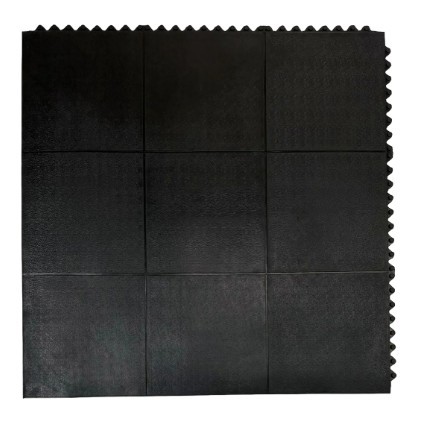
Single mats, in a fixed size, are ideal for individual workstations, such as quality control, packing stations or service points. Where greater flexibility is required, modular (tiled) mats are used. These consist of interlocking tiles that can be freely extended, cut to fit the unusual shape of a hall, or have individual damaged segments replaced without the need to purchase a whole new mat. Roll-fed mats, on the other hand, are a solution designed for long production lines and continuous work zones, where staff move along the entire length of the workstation.
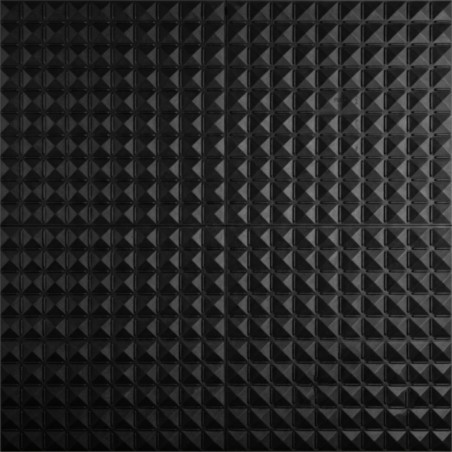
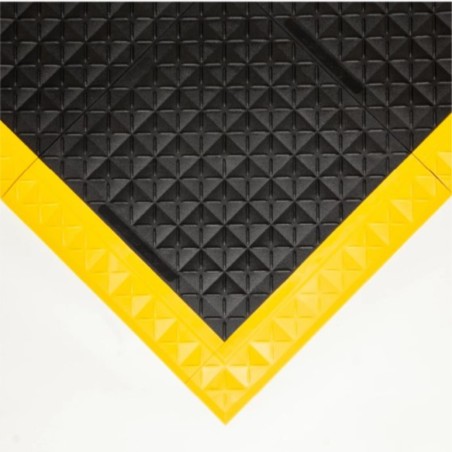
A separate category comprises mats with specialised functions, such as ESD mats for electronics assembly areas, fire-resistant mats for use around welding stations, and mats with a diamond-patterned or grooved surface, which provide additional grip in areas exposed to moisture and oil spills.
Are you lacking experience and don’t want to take any risks? Let the 4safety team help you. We’re here to assist you every step of the way. Simply get in touch with us by phone or email. Our advisor will provide comprehensive, step-by-step guidance to help you choose the right equipment, tailored to your individual needs.
Related posts
Case study: implementation of a flexible barrier system in a production plant!
Steel or flexible: which industrial bumpers should you choose?