Our regional advisors will help you choose a product tailored to your needs | We provide installation, service, and inspections! | Only trusted suppliers!
Shopping cart (0)
- Products
-
Services
- Spill response training
- Lockout Tagout implementation
- Inspection and maintenance of safety cabinets
- Lockout Tagout training
- Office equipment and layout
- Selection and installation of industrial matting
- Delivery and installation of flexible barriers
- Marking of traffic routes
- Traffic risk assessment audit
- ATEX technical audit
- Selection and installation of industrial safety fencing
- Catalog
- Case study
- Blog
- About us
- Contact
Ergonomic mats – Price, applications and availability
Every hour spent on a hard floor takes its toll. Knee or calf pain, lower back stiffness and swollen feet at the end of a shift are such common complaints in manufacturing and warehouse environments that many workplaces regard them as an inevitable cost of standing work. However, ergonomic research and clinical data have shown for years that an ergonomic mat can change this. It is not a question of comfort, but of safety and work efficiency.
Would you like to see the research findings and discover for yourself that ergonomic mats can boost your team’s productivity? In the article below, we answer a range of questions. Make the most of our expertise and join the ranks of 4safety’s customers today.
Contents
What are ergonomic mats and why are they important for health and safety?
Types of ergonomic mats — which type suits your workstation?
Standards, certifications and technical specifications – what to look out for when buying?
Where to buy ergonomic mats and how to order them for an industrial hall?
What are ergonomic mats and why are they important for health and safety?
An ergonomic mat (also known as an ‘anti-fatigue’ mat) is a modern piece of health and safety equipment for standing workstations. It differs fundamentally from an ordinary floor mat or industrial carpet, as its effectiveness is based on precisely engineered resilience. An ergonomic mat is neither too soft nor too hard, and has a tangible effect on reducing the strain on the worker’s body.
How does it work? Learning behind an ergonomic mat
When an employee stands on a hard floor, the muscles of the legs and torso assume a static position. They remain tense without any active movement. Blood pools in the lower limbs, circulation slows down, and the veins have to work harder. After 40–60 minutes, the first signs of pain appear – first in the feet, then the knees and lower back, and finally even the neck and head.
The ergonomic mat breaks this cycle through a phenomenon known as proprioceptive muscle activation. The mat’s slightly unstable surface forces the body to make constant, subtle micro-adjustments to its balance. These are imperceptible to the conscious mind, as the employee does not need to actively maintain their balance and simply stands there. Nevertheless, the muscles of the calves, thighs and even the core work in time with these micro-movements. The effects are measurable:
a reduction in lower limb discomfort of up to 54% compared with standing on a hard floor,
a 28% reduction in overall fatigue after a work shift when the mat is correctly selected,
a 3–5-fold improvement in venous blood return to the heart – thanks to the active work of the calf muscles acting as a ‘pump’,
a delay in the onset of lower back pain by approx. 40 minutes during a shift.
The above figures are the result of ergonomic studies conducted under test conditions. We are therefore confident that at 4safety you will find industrial ergonomic anti-fatigue mats that guarantee effectiveness.
Ergonomic mats and employment law — What do the regulations say?
The use of ergonomic mats is not mandatory at standing workstations. However, their use may be brought within the scope of the provisions of Article 207 of the Labour Code — which imposes a duty on employers to organise work in safe and hygienic conditions. Further details can be found in PN-EN 614-1, which sets out ergonomic principles for the design of workstations, and in PN-EN ISO 9241-5, which regulates the ergonomic requirements for workstations involving prolonged standing.
If employees spend more than 4 hours a day standing at their workstations and complain of musculoskeletal disorders (MSDs), the absence of an ergonomic mat may be an important factor to consider in terms of investment. Ergonomic mats are not a legal requirement, but given their effectiveness, they are a sensible choice for an employer.
Why is this important for employers?
Investing in ergonomic mats is a way of mitigating risk. Workplaces that have introduced anti-fatigue mats at standing workstations report:
lower sickness absence due to musculoskeletal disorders,
lower staff turnover on production lines (physical strain is one of the key factors behind staff leaving),
greater concentration and productivity in the second half of a shift — a tired worker makes more mistakes and has slower reaction times,
a reduction in micro-injuries (MSDs), which account for as much as 30–40 per cent of all occupational illnesses in the manufacturing and warehousing sectors.
If an ergonomic mat eliminates even one day of absence per year per employee, and the cost of absence (social security contributions, replacement staff, lost production) amounts to 400–600 zł, a mat costing 200–300 zł pays for itself before the end of the season.
Types of ergonomic mats — which one is right for your workstation?
Choosing an ergonomic mat is a decision that must take into account specific environmental conditions, the nature of the work and the technical requirements of the workstation. An incorrect choice fails to deliver ergonomic benefits and reduces the mat’s lifespan from several years to just a few months.
The basic classification is based on two factors – the material used and the intended environmental use. Below, we present the four main categories available in the 4safety range.
Foam mats (W series) — Dry working areas and static work
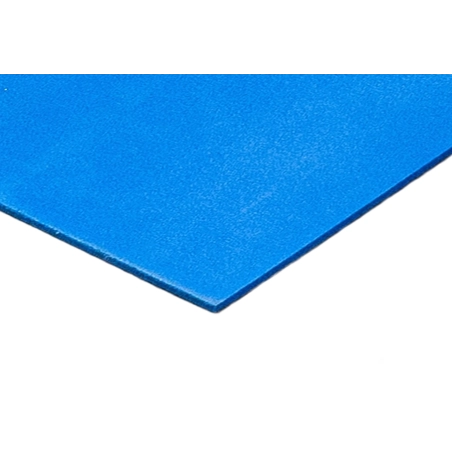
PU or EVA foam mats are a classic solution for workstations where an employee stands in one place performing repetitive manual tasks – such as assembly, packaging, quality control or operating precision equipment. Foam of the appropriate density absorbs pressure and triggers the muscle micro-activation effect described earlier.
When to use them?
Dry environment – no contact with liquids, oils or chemicals.
Intermittent work for up to 3 hours a day (e.g. W1) or continuous work for up to 8 hours (e.g. W2) – the difference lies in the density of the foam. Longer periods of standing require a firmer, more resilient core.
Workstations where ease of cutting to size is important – foam mats are available in rolls and standard sizes, and can be cut to non-standard dimensions to fit the work area.
What should you watch out for?
The foam density must be matched to the user’s body weight. A mat that is too soft for a heavy worker will lose its resilience within weeks, negating the entire ergonomic benefit. If you need help selecting the right equipment, the 4safety team of advisers is at your disposal. Contact us now.
ESD foam mats (W3/W4 series) – Electronic and precision workstations
A variant designed for environments requiring static electricity control. The ESD mat serves a dual purpose – ergonomic (reducing fatigue when working whilst standing) and protective (controlling the dissipation of electrostatic charges, thereby protecting electronics from damage caused by ESD discharges).
Key parameters to consider when purchasing include compliance with the IEC 61340-4-1 standard. This specifies the surface resistance of the mat, which should be within the range of 10⁵–10⁹ Ω. However, a properly configured ESD workstation requires three components:
an ESD floor mat,
an ESD table mat,
operator earthing (a wrist strap or conductive ESD footwear).
If any link is missing, the circuit cannot be closed and the workstation remains unprotected. Remember that with 4safety, you can assemble the necessary equipment and create a safe workstation for your specialists.
When to use it?
Manufacture and assembly of electronics, components and sensors.
Laboratories and test benches with ESD-sensitive equipment.
Cleanrooms, where control of both cleanliness and static electricity is required.
Modular rubber mats (M series) — Dynamic, multi-shift operation
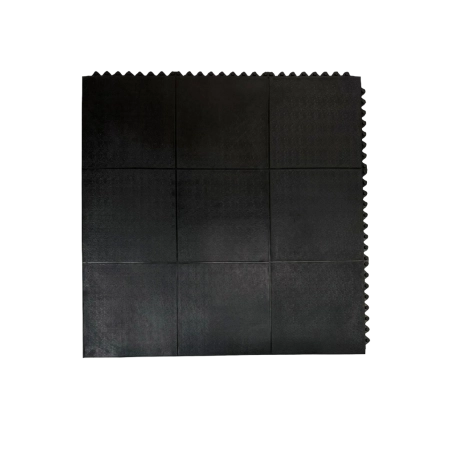
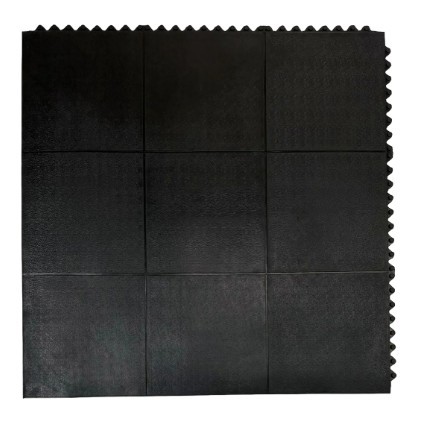
The M-series mats are made from industrial rubber in the form of large tiles, which can be combined to create a customisable area. They are characterised by a flat, hard surface which, whilst seemingly at odds with ergonomics, has been deliberately designed for dynamic work.
When a worker moves quickly between workstations, a mat that is too soft hinders movement and puts strain on the knees during rotation. The modular rubber provides even support at every point whilst cushioning the hardness of the floor.
When to use?
Production lines with rotating workstations or movement along the length of the machine.
Continuous, multi-shift operation 24/7 – the rubber withstands intensive use without deformation.
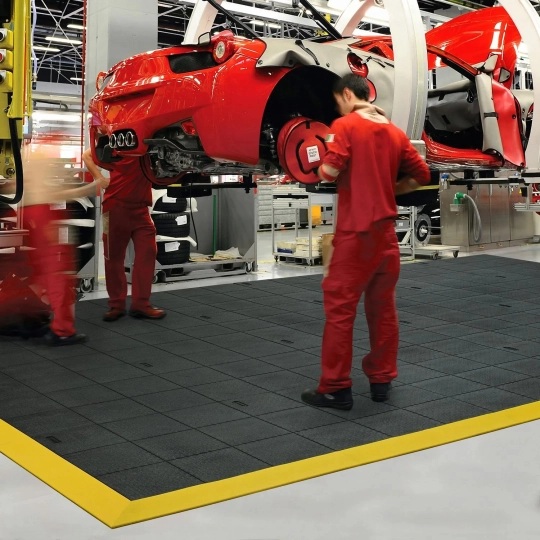
Oily and greasy environments (M2 series) – special rubber compounds resistant to industrial oils, hydraulic fluids and lubricants. The M2 version is also ESD-certified.
Areas requiring regular floor cleaning – rubber resistant to water, cleaning agents and high pressure.
Modular rigid PVC mats (H series) – Extreme environments
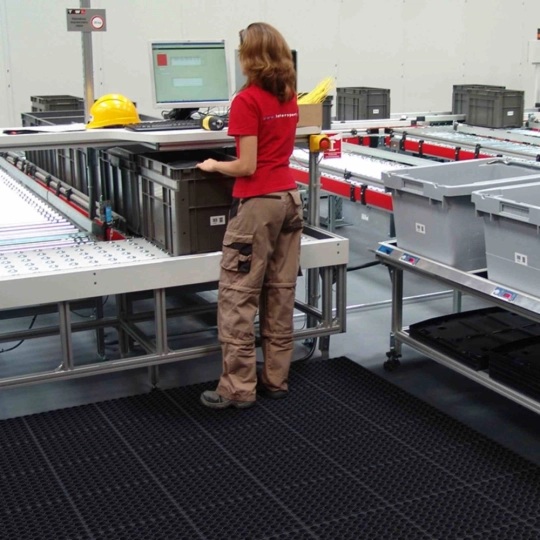
The H series of ergonomic mats is the widest-ranging and most specialised category in the 4safety range – designed for conditions in which standard mats would not withstand the wear and tear. The tile format, featuring a glue-free (snap-fit) connection system, allows for quick installation, reconfiguration and replacement of individual elements without the need to dismantle the entire area.
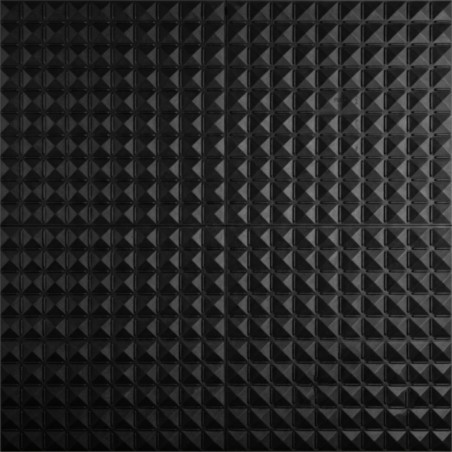
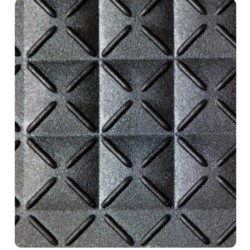
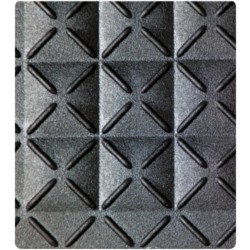
Compression Flex™ technology consists of a network of pressure domes beneath the tile’s surface, which flex and spring back – simulating an ergonomic effect similar to foam, whilst retaining the durability of rigid PVC. The maximum load-bearing capacity of the H series is 9.8 t/m². This means that a forklift truck can travel over such a mat without damaging the structure (H7 series).
Environmental variants of the H series – Selection based on risk
| Seria | Środowisko | Cecha szczególna |
| H1 | Suche, przemysłowe | Compression Flex™, zarządzanie kablami pod matą |
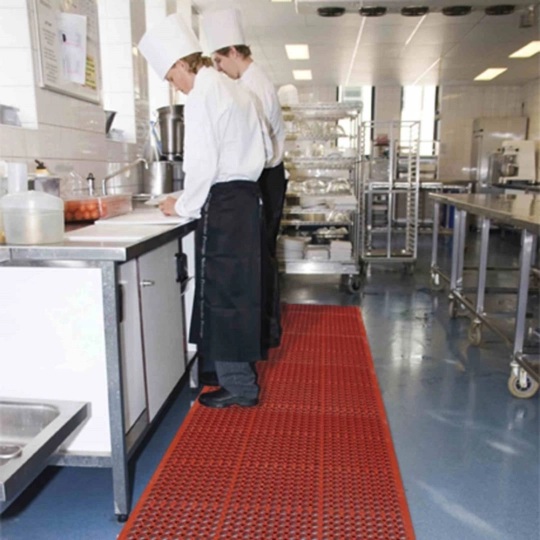
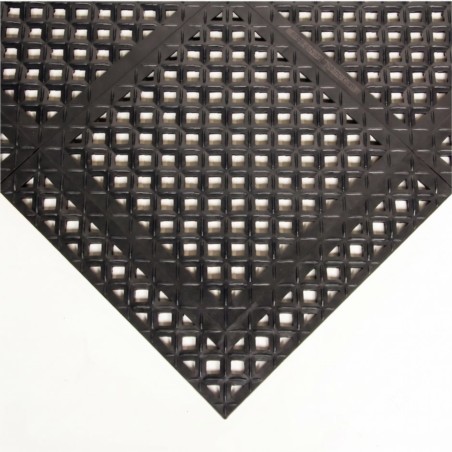
| H2 | Mokre, z ciekami | Otwarta struktura – ciecze odprowadzane pod matę |
| H3 | Olejowe, śliskie | Powłoka antypoślizgowa, klasa R wyższa |
| H4 | Olejowe + ociekające | Kombinacja otwartej struktury i antypoślizgu |
| H5 | ESD + ekstremalne | Compression Flex™ + certyfikacja ESD |
| H6 | Ruch kołowy | Wzmocniona stabilność na ruch wózków ręcznych |
| H7 | Ruch wózków widłowych | Nośność do wózków widłowych, krawędzie HD |
| H8 | Antybakteryjne, suche | ISO 22196:2011 – przemysł spożywczy, farmacja |
| H9 | Antybakt. + ociekające | ISO 22196:2011 + otwarta struktura |
ISO 22196:2011 certification in variants H8 and H9 indicates that the material has been laboratory-tested to confirm its ability to inhibit bacterial growth on the surface of the mat. This is a key requirement for procurement in the food, pharmaceutical and medical industries, where mats are subject to GMP and HACCP audits.
Standards, certificates and technical specifications – what should you look out for when buying?
In an industrial setting, an ergonomic mat must meet specific technical requirements. So find out about the key specifications at 4safety.
Slip resistance – R classes according to DIN 51130
This is one of the most important safety parameters for floor mats. The DIN 51130 standard defines five slip resistance classes for floor surfaces and mats in industrial environments – from R9 to R13. Remember that the higher the number, the more effective the protection in conditions where slipping is a risk.
How does this work in practice?
R9 – dry environments, minimal slip risk. Suitable for dry assembly and packaging workstations.
R10 – dry environments with the possibility of occasional moisture. The standard for most production halls without exposure to liquids. Class R10 includes, amongst others, the H1 series of ergonomic mats.
R11 – wet environments or those with oily vapours. Required in machining areas and near machines cooled with emulsion.
R12–R13 – environments with intensive contact with oils, greases and cooling emulsions. Essential in machine lubrication areas, at presses and at CNC machining stations.
It is a mistake to select an R-class mat with so-called ‘margin’, without analysing the working environment. An R13 mat in a dry workstation is more expensive, more difficult to clean and offers no added value. The choice should be based on an occupational risk assessment for the workstation.
Fire resistance – Class Cfl-s2 in accordance with EN 13501-1
In environments where welding or thermal cutting is carried out, or where hot metal spatter may come into contact with the floor surface, the fire resistance of an ergonomic mat is no longer a secondary consideration. The EN 13501-1 standard classifies building materials and floor coverings according to their reaction to fire. Class Cfl-s2 means:
Cfl — a flame-retardant material with a limited contribution to fire at floor level,
s2 — low smoke emission during combustion (limited toxicity and smoke production).
This is the minimum class recommended for areas where there is a risk of sparks. The H1 series is Cfl-s2 certified. It is therefore a suitable solution for welding stations and fire-risk areas in industrial halls.
Please note! The absence of a fire safety certificate for a mat in a fire hazard zone may be identified by a fire safety expert or during an inspection as a non-compliance issue when applying for permits or following incidents.
ESD properties – IEC 61340-4-1 standard
Static electricity poses a costly risk to both employees and the company. In environments involving electronics manufacturing, the handling of integrated circuits or the assembly of precision components, a discharge of several hundred volts can permanently damage a component without leaving any visible signs of damage. The fault only becomes apparent once the product reaches the end customer.
The IEC 61340-4-1 standard sets out the requirements for ergonomic flooring and mats in ESD (Electrostatic Discharge) zones. The surface resistance of the mat is crucial. It should fall within the range of 10⁵–10⁹ Ω – sufficient to dissipate electrostatic charges, yet safe for the user.
Antibacterial properties – ISO 22196:2011
In the food, pharmaceutical and medical sectors, floor surfaces are subject to hygiene requirements. The ISO 22196:2011 standard specifies a method for measuring and evaluating the antibacterial activity of non-porous materials – including ergonomic mats. A certificate issued in accordance with this standard confirms the laboratory-tested ability to inhibit bacterial growth.
The H8 and H9 variants are certified to ISO 22196:2011. This makes them suitable for use in environments subject to the HACCP system, GMP audits and BRC or IFS requirements. The ergonomic mat thus becomes an integral part of the food or product safety management system.
Where can I buy ergonomic mats and how do I order them for an industrial hall?
Start by carrying out a workstation survey. Draw up a list of standing workstations in the workplace. For each one, specify the dimensions of the work area (an ergonomic mat should extend at least 30–40 cm beyond the outline of the workstation in all directions of the worker’s active movement), the number of shifts, the number of hours spent standing, and the body weight of a typical user.
Please note! If people with significantly different body types work at a workstation, it is worth making a note of this.
For each workstation or zone, specify the environment – whether it is dry, wet, oily/greasy, a welding environment, ESD, involves forklift traffic, or requires antibacterial hygiene. A single workstation may combine several requirements – e.g. an oily environment + ESD + 24/7 operation. Such combinations often indicate that the H series is the only suitable solution.
Next, check whether the facility or industry imposes any additional requirements. ESD zones require IEC 61340 certification, welding areas require Cfl-s2, whilst the food and pharmaceutical industries require ISO 22196 and compliance with REACH/Phthalate-Free. These certificates should be included in the tender specifications as product qualification criteria.
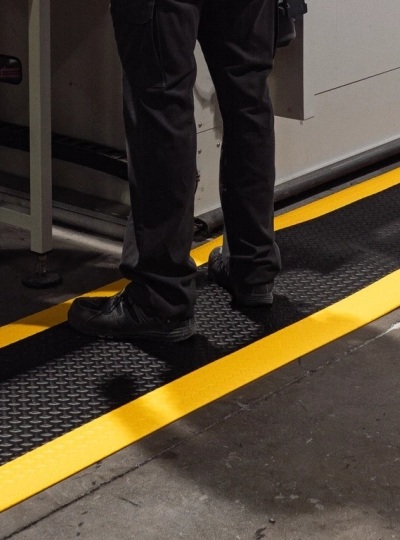
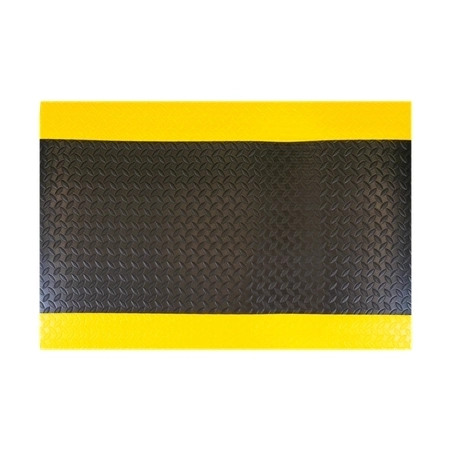
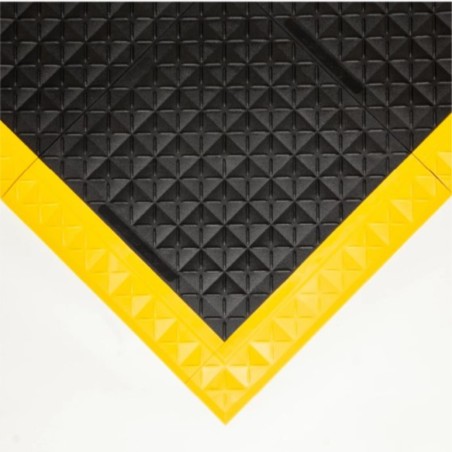
Bear in mind that safety ramps are a key factor in one of the most common types of accidents in production halls. Wherever a worker steps onto or off the mat, edge ramps (bevels) are essential. For the H series, yellow-and-black safety ramps compatible with the tile layout are available.
Before ordering a large batch, it is worth requesting a sample or taking advantage of the technical consultation offered by 4safety. We can put you in touch with a specialist who, based on a description of the workstation or a floor plan of the hall, will help you identify the appropriate product variants and prepare a quotation.
Common mistakes and how to avoid them?
- Buying the cheapest ergonomic mat. A mat without ESD certification in an ESD zone carries the potential cost of complaints and faulty components. A mat without Cfl-s2 certification at a welding workstation poses a fire risk. The cost of a proper ergonomic mat is a fraction of the cost of an incident.
- Too small. An ergonomic mat smaller than the employee’s active movement zone means that, during natural work movements, the employee regularly steps off the mat, losing the ergonomic benefit, whilst the edge of the mat becomes an obstacle or even a hazard. The mat should cover the movement zone with a 30–40 cm margin on each active side.
- Lack of edge ramps. Tripping over the edge of a mat 12–20 mm thick poses a real risk of a fall. Safety ramps are an essential component of the system; without them, an ergonomic mat does not meet the requirements for safe installation.
- Incorrect cleaning and maintenance. Harsh chemicals, high-pressure washers and metal brushes damage the anti-slip coatings and shorten the mat’s service life. Always follow the recommendations in the user manual or seek expert advice from 4safety consultants.
- Please also bear in mind that ergonomic mats used in areas with forklift traffic, in oily environments or during multi-shift operations should be inspected regularly. We recommend periodic checks of the condition of the modular joints, the integrity of the edges and the condition of the anti-slip surface. The frequency of inspections depends on the intensity of use.
Related posts
Why is it worth using ergonomic mats?
Anti-slip protection