Wiedza
- Case study - implementation of the LOTO system in a production plant
- Lockout/Tagout - what is it and why is it worth introducing LOTO?
- Why is it worth implementing a LOTO system with Marcin from 4safety?
- Case study: implementation of a flexible barrier system in a manufacturing plant!
- Steel or flexible: which industrial bumpers should you choose?
- Case study: protection of high-bay racking with a flexible barrier system
- How to safely store lithium-ion batteries?
- Explosion of lithium-ion batteries — how to avoid it?
- Hazardous substances in the storage container
- Safe crane operating zone
- LED safety projectors
- Classification of flexible barriers
- Everything about IBM
- Do It Yourself - industrial printers
- The meaning of the padlock in the LOTO system
- Why is it worth using ergonomic mats?
- Anti-slip protections
- A catch basin is good practice or a regulatory requirement?
- Industrial shelving - types and applications
- About employee comfort and safety
- Frost and structural monitoring of the facility
- What information should a nameplate contain?
- How to prevent accidents with safety containers?
- Fire-resistant cabinet – what should you pay attention to when buying?
- Selection of a spill containment tray
- Hazardous substances - what to do in the event of a leak?
- Hazardous materials under the supervision of an ADR advisor
- What problems do industrial barriers solve?
- Color coding of pipelines – colors, arrows, inscriptions
- Lasers for communication routes
- Natural neutralization of substances
- Energy-intensive barriers – Types, characteristics and application
Frost and structural monitoring of the facility
Winter conditions make it difficult to safely manage flat roofs. Measuring the snow cover and clearing snow from the roof become particularly problematic. How can both tasks be carried out safely? We have prepared an article for you in which we explain how frost and structural monitoring of a facility are related.
Winter is a particularly difficult period for managers of large-area facilities. Obviously, the greatest challenges are associated with snowfall. Sudden, intense snowstorms result in large amounts of heavy snow remaining on the roof. But just as troublesome as snowfall are subzero temperatures.
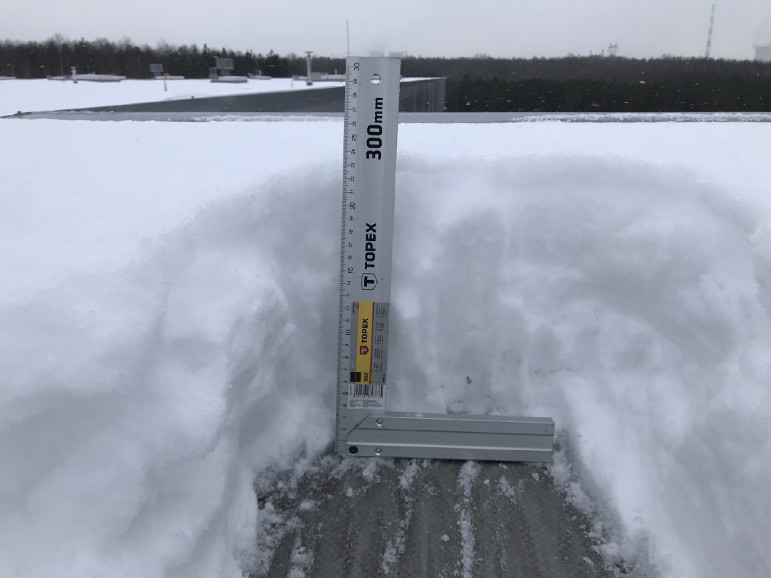
The impact of frost on snow cover monitoring
A properly prepared roof snow removal instruction manual contains precise information on exactly when the process of removing snow from the roof should begin. Generally, it is recommended to start clearing a flat roof when the load reaches 80% of the calculated snow load or 80% of the structural deflection. From the moment such a condition is registered, the manager should decide to begin snow removal, for example based on notifications delivered by Weather Alerts.
Problems for the facility manager begin when the temperature drops below minus five degrees Celsius. Why is this such an important value? Because in the vast majority of membrane roof cases, the warranty does not cover any damage resulting from stepping onto the roof at a temperature equal to or lower than minus five degrees Celsius. This is because in such conditions the membrane becomes brittle and therefore susceptible to damage.
Therefore, if the facility manager uses manual methods to measure the thickness of the snow cover, then when frost occurs, they must face serious challenges. There is no possibility of precisely measuring the thickness of the cover, which also makes it impossible to estimate the load. As a result, the manager does not have the necessary information that would allow them to make a reliable decision about starting roof snow removal.
It is worth remembering that carrying out a comparative measurement, for example on the ground, is not reliable. This is because snow is distributed differently on roofs and also usually remains there longer. This phenomenon is related to the thermal inertia of well-insulated roofs.
The impact of frost on flat roof snow removal
Subzero temperatures also significantly hinder the process of removing snow from the roof itself. In this case, the risk is twofold. The manager faces not only the threat of roof damage, but also the loss of the possibility to seek membrane repair under warranty. In addition to the fact that frost makes it impossible to step onto a membrane roof, when the temperature drops below minus five degrees, mechanical snow removal also poses a high risk of major damage to the membrane. The result is leaks that are difficult to identify and expensive to repair.
So how can flat roof maintenance be managed effectively in winter and during frosts? In a way that ensures both effective snow removal and care for the facility’s structure?
Frost and structural monitoring of the facility – automation of measurements
To avoid having to go onto the roof, it is worth investing in a system for automatic measurement of the facility’s structural condition. Installed sensors – for example, Sense S-One sensors – monitor deflection and the verticality of columns. The data collected in this way is then made available in the SENSE Smart Roof application. This gives the manager convenient access to the data at any time. The need to go out onto the roof is reduced to a minimum. At the same time, the precision of measurements is significantly increased. This is because electronic, highly precise devices replace humans.