Wiedza
- Case study - implementation of the LOTO system in a production plant
- Lockout/Tagout - what is it and why is it worth introducing LOTO?
- Why is it worth implementing a LOTO system with Marcin from 4safety?
- Case study: implementation of a flexible barrier system in a manufacturing plant!
- Steel or flexible: which industrial bumpers should you choose?
- Case study: protection of high-bay racking with a flexible barrier system
- How to safely store lithium-ion batteries?
- Explosion of lithium-ion batteries — how to avoid it?
- Hazardous substances in the storage container
- Safe crane operating zone
- LED safety projectors
- Classification of flexible barriers
- Everything about IBM
- Do It Yourself - industrial printers
- The meaning of the padlock in the LOTO system
- Why is it worth using ergonomic mats?
- Anti-slip protections
- A catch basin is good practice or a regulatory requirement?
- Industrial shelving - types and applications
- About employee comfort and safety
- Frost and structural monitoring of the facility
- What information should a nameplate contain?
- How to prevent accidents with safety containers?
- Fire-resistant cabinet – what should you pay attention to when buying?
- Selection of a spill containment tray
- Hazardous substances - what to do in the event of a leak?
- Hazardous materials under the supervision of an ADR advisor
- What problems do industrial barriers solve?
- Color coding of pipelines – colors, arrows, inscriptions
- Lasers for communication routes
- Natural neutralization of substances
- Energy-intensive barriers – Types, characteristics and application
Steel or flexible: which industrial bumpers should you choose?
Steel or flexible barriers? See the comparison and choose the best ones.
Steel or flexible barriers? See the comparison and choose the best warehouse barriers. They protect infrastructure, machines and, most importantly, people’s health and lives.
Comprehensive facility outfitting with the right barriers involves costs in the range of 400k - 5 million PLN. That is why choosing the right protections already at the hall or warehouse design stage is important.
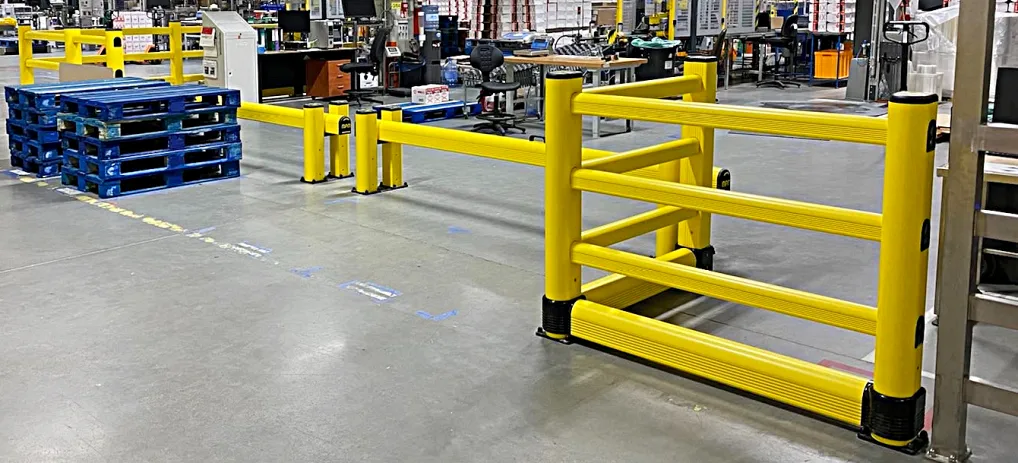
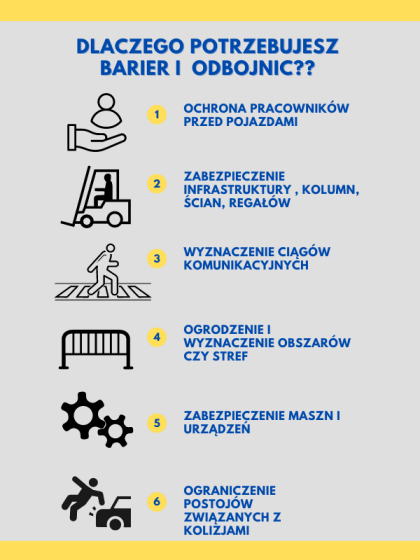
On the market, you can still encounter the belief that steel barriers, true to steel, are more durable, harder and more solid.
They are often recommended for protection in industrial and warehouse environments as so-called top-down guidelines. But are these really the most important parameters worth considering? Would you rather hit something solid but flexible, absorbing the impact, or hard and unyielding steel?
Let’s take a closer look at industrial barriers.
- Barriers made of steel, painted, additionally protected against corrosion or UV rays, can also be galvanized.
- Barriers made of wood clad with metal profiles.
- Flexible barriers, i.e. made of plastics, polymer, polyethylene, polyurethane, technopolymer.
What are the advantages of steel barriers (black steel, stainless steel)?
- They work well for protecting pedestrians, marking zones, traffic route areas, etc.
- Easy to clean and maintain - especially important in the food industry.
- They work well in the pharmaceutical industry and CleanRoom zones.
- You can easily adapt them to your needs: dimensions, aesthetics, colors.
- They can be protected against corrosion.
- Various protective coatings can be applied to them.
- They are classified as not contributing to fire.
- Resistance to weather conditions - it depends on how they are protected. They can be protected against UV radiation (this is an additional option). Painted with ordinary paint, they will not guarantee such resistance.
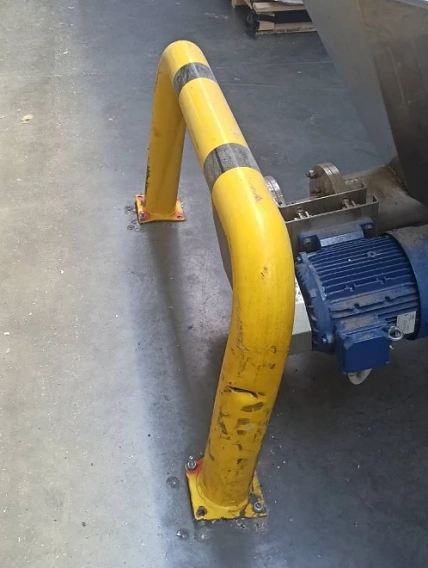
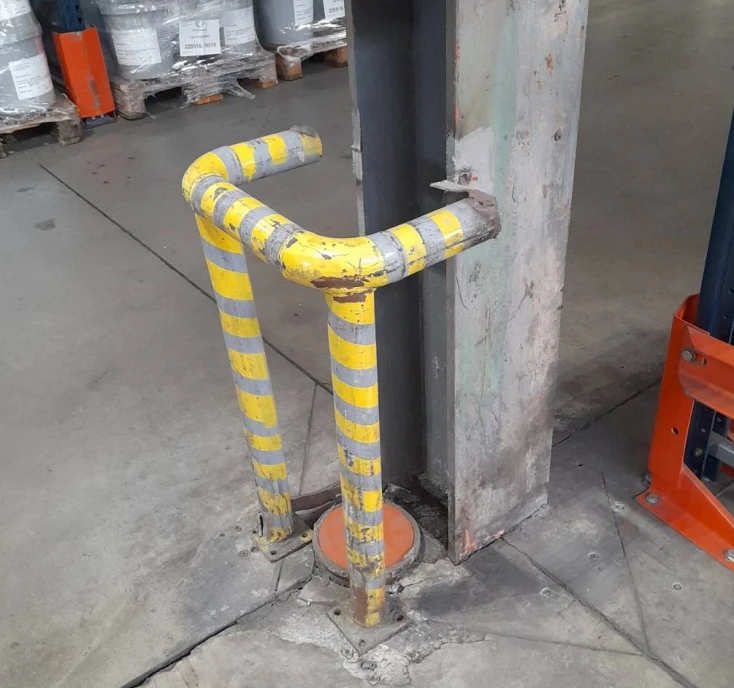
What do steel barriers do poorly? Or what do flexible ones do better?
Steel barriers can be a bit “single-use” under stronger impacts; they may come loose from their anchors, sometimes damage the impacting vehicle and the floor. When they come loose, the protected object may also be damaged.
Flexible barriers, thanks to the high density of the material, are very durable and long-lasting. They absorb the force of impact and return to their original shape after a collision. They can withstand a much greater impact force without damage to themselves or the substrate. Thanks to this, you minimize repair and replacement costs for floors, columns and machines.
The most important difference between steel and flexible barriers is that flexible ones are tested and certified for impact resistance according to standards and norms, undergoing TUV assessment.
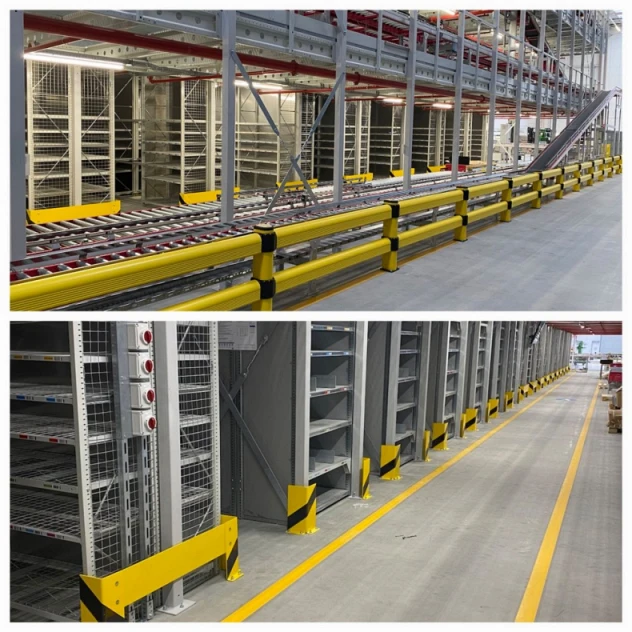
Pay attention to the photos next to the metal barriers protecting the racks - a 2.5 m H-profile made of 2 mm sheet metal mounted on two bolts - there is no physical possibility that such a barrier will not break off or come loose even in an impact at 3 km/h.
If you choose wooden barriers, require a CE certificate for each section - the wood still will not be tested as a barrier, but at least it will maintain its parameters.
https://youtu.be/FK_5fLmIRgsAesthetic appearance - flexible barriers look good even after long-term use. Thanks to intense colors and a material resistant to scratches and corrosion and easy to clean. The barriers are highly visible and clearly mark traffic zones while not requiring painting. The material is low-porosity and does not attract dirt, and scratches do not cause unsightly color peeling.
Energy-absorbing barriers can be selected according to the type of traffic, making them resistant even under intensive vehicle traffic.
Industrial barriers come in different thicknesses depending on the type and manufacturer. You certainly know how important it is to maximize protection while using minimal space. Barriers should be compact, installed as close as possible to the protected parts, so that you leave more room for work. This is mainly an advantage of PVC polymer barriers - you will find them in our offer.
See the compact flexible barriers we offer.
When you do not want to increase the fire load of the hall due to a greater amount of plastic, choose fire-resistant, self-extinguishing, certified barriers classified as V0. Additionally, this type of barrier is resistant to fuels, chemicals and oils.
UV resistance - depending on the manufacturer, you can expect barriers resistant to UV radiation both in technical parameters and color retention – this should be verified, because not every manufacturer provides such a guarantee.
Modularity – you can adapt the length of individual barriers to your needs so that they fit your hall as well as possible. You can change the length even after installation
. Flexible bumpers are made of non-toxic material, which is why they are ideal for use in the food and pharmaceutical environment. Flexible, modular bumpers are easier to implement and connect to the existing infrastructure in a given plant. A basis for automation - warehouse bumpers easily integrate with motion sensors, projectors, and warning lights. Thanks to this, you can create a comprehensive solution that increases safety in your plant.
Installation looks similar in both cases. You either anchor mechanically or chemically. It is important that this is carried out by an experienced team. Proper installation also determines the warranty and compliance with barrier performance requirements regarding impact resistance.
Additionally, it is worth remembering that flexible bumpers in low temperatures, refrigerated conditions, or outdoor environments in a climate typical for Poland, should have a different polymer blend suitable for operation in sub-zero temperatures.
https://youtu.be/gUZEX1kKdG0Comparison of the costs of flexible and steel bumpers.
Steel barriers will be about 20-30% cheaper than flexible ones, but in their basic version. It is worth knowing that any protection: anti-corrosion, UV protection, etc. will involve additional costs. Secondary floor damage resulting from impact, replacement of barriers with new ones after impact... Moreover, metal barriers do not have a strength standard, so comparing them 1:1 is difficult.
Industrial steel bumpers can generate additional costs in the event of damage through repairs to floors, columns, machines, and replacing barriers with new ones. Sometimes there is no room to move the barrier - the number of previous anchoring points has already been exhausted. Metal bumpers are good protection, but only until the critical point is reached and they are torn out from the anchor and concrete base.
Sometimes the best solution is a mix of flexible and steel barriers, an example from one of the automotive plants in Greater Poland that we equipped in 2022.
There is also one more advantage of flexible barriers that we know from forklift operators' accounts - flexible bumpers forgive mistakes and allow for a gentle approach with contact without damaging the barrier, scratching the forklift, and without the moment of shaking the goods on the pallet.
What does the selection and installation of warehouse bumpers with 4safety look like?
- we carry out an audit/site inspection
- if necessary, OZW written traffic hazard assessment in the plant
- proposal of solutions extending the effectiveness of flexible barriers, e.g. flexible gates opened/closed using a motion sensor, virtual signs, interactive safety lines displayed when leaving the safe zone
- visualization and design in DWG
- assembly and installation without downtime - we know how important it is in plants to maintain continuity of production / transport, which is why our installation teams also work in the evenings and on weekends.
See how flexible bumpers behave on impact:
https://youtu.be/IXB_5HJooXAhttps://youtu.be/XahJxJ3tVGg