Wiedza
- Case study - implementation of the LOTO system in a production plant
- Lockout/Tagout - what is it and why is it worth introducing LOTO?
- Why is it worth implementing a LOTO system with Marcin from 4safety?
- Case study: implementation of a flexible barrier system in a manufacturing plant!
- Steel or flexible: which industrial bumpers should you choose?
- Case study: protection of high-bay racking with a flexible barrier system
- How to safely store lithium-ion batteries?
- Explosion of lithium-ion batteries — how to avoid it?
- Hazardous substances in the storage container
- Safe crane operating zone
- LED safety projectors
- Classification of flexible barriers
- Everything about IBM
- Do It Yourself - industrial printers
- The meaning of the padlock in the LOTO system
- Why is it worth using ergonomic mats?
- Anti-slip protections
- A catch basin is good practice or a regulatory requirement?
- Industrial shelving - types and applications
- About employee comfort and safety
- Frost and structural monitoring of the facility
- What information should a nameplate contain?
- How to prevent accidents with safety containers?
- Fire-resistant cabinet – what should you pay attention to when buying?
- Selection of a spill containment tray
- Hazardous substances - what to do in the event of a leak?
- Hazardous materials under the supervision of an ADR advisor
- What problems do industrial barriers solve?
- Color coding of pipelines – colors, arrows, inscriptions
- Lasers for communication routes
- Natural neutralization of substances
- Energy-intensive barriers – Types, characteristics and application
What information should a nameplate contain?
What information should a nameplate contain?
The nameplate is a key element of every device or machine, because it contains information about its parameters and method of use.
In this article you will learn:
1. What is a nameplate?
2. Where is it usually placed?
3. What information should it contain?
4. What are the requirements regarding its description and markings?
1. What is a nameplate?
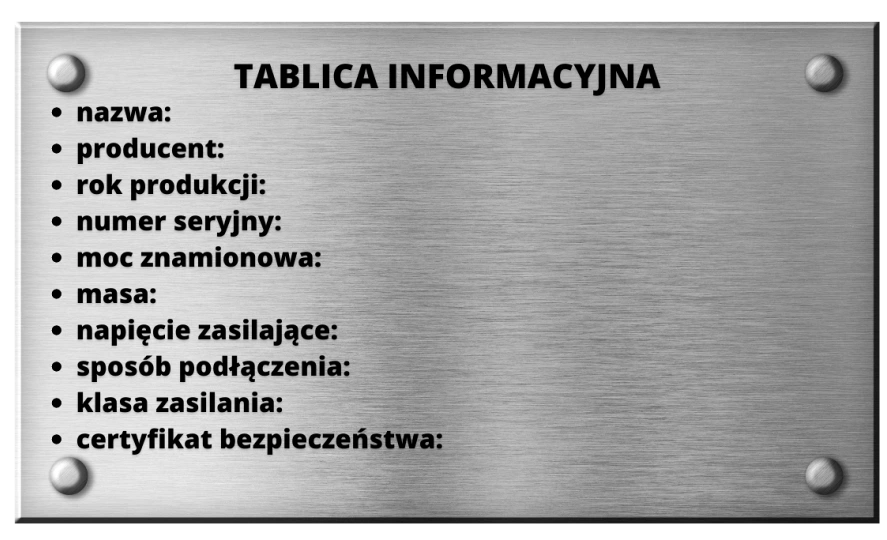
A nameplate is a small plate on which information about a device or machine is placed. Its purpose is to ensure user safety and enable the proper use of a given device. The plate should include all important information such as: supply voltage, power, or application, as well as the serial number and year of manufacture.
A machine nameplate performs many different functions. First of all, it enables the identification of the machine and its owner. Thanks to this, in the event of a failure or accident, the machine can be easily identified and appropriate actions can be taken. This speeds up the repair process, especially in large machine parks.
Another important element of the nameplate is instructions regarding safety and operation. These instructions are essential to ensure the safety of operators and employees while working with the machine. These instructions contain information about the rules for safe use of the machine, such as the method of operation, emergency procedures, recommended practices, etc.
A machine nameplate is also important from the point of view of compliance with regulations and safety standards. In accordance with point 1.7.3 of Annex I of the Machinery Directive MD (2006/42/EC), every machine should be marked in a visible, legible, and durable manner. The information must be provided in Polish, in a font that allows easy reading.
2. Where should the device nameplate be placed?
The nameplate is usually placed on the machine or device in a location that is easily visible and accessible to the user. It is usually located on the outer part of the housing, but in some cases it may also be placed inside the device or on its casing.
If it is not possible to place the required information on the device (e.g. when the device is too small), it is permissible to attach an additional plate or label to the device.
The durability of the plate is important because it must not be destroyed throughout the entire period of use of the machine.
3. What information should a nameplate contain?
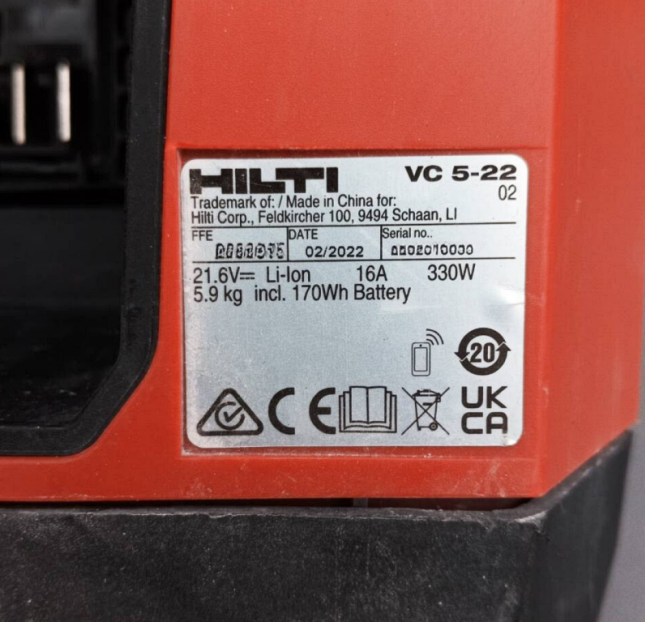
The nameplate should contain a range of information about the device. The most important of these are:
- Name and type of device or machine;
- Manufacturer of the device or machine;
- Serial number of the device or machine;
- Supply voltage;
- Power of the device or machine;
- Weight of the device or machine;
- Date of manufacture.
In addition to standard identification data, such as the manufacturer or serial number, the plate should also contain:
- CE mark;
- Safety requirements regarding use;
- Description of how to use it;
- Markings concerning the countries in which the device or machine may be used;
- Safety markings.
The nameplate should contain information about safety markings, such as the degree of protection against dust and water, as well as the insulation class.
In some cases, there should also be information about the intended use - e.g. for use in an ATEX zone.
4. Nameplate - requirements regarding material and markings?
Legibility: The plate must be legible and easy for users to understand. All information should be clearly written and clearly visible.
Durability: The nameplate must be made of durable materials resistant to mechanical damage and weather conditions. The most common nameplates are made of metal or plastics, but nameplates made of paper or laminate can also be found.
It is important that the plate is resistant to abrasion, moisture, corrosion, and sunlight.
The material should be matched to the operating conditions of the given device.
The plate should be permanently attached to the machine and must not be easily removable.
Location: the nameplate must be placed in a visible place on the machine. It is best for the nameplate to be placed near the location where the machine's control elements are located.
Data and language: The nameplate should be written in the national language of the country in which the machine will be used. If the machine will be used in a country where other languages are used, the nameplate must be written in the appropriate language.
The content must comply with the requirements of the law in force in the given country. In Poland, this will be the directive of the European Parliament
What should you do if you purchased a machine without a nameplate?
In such a situation, you should contact the machine manufacturer to issue a nameplate and provide the technical documentation. If the machine was not manufactured in Poland, you should contact the manufacturer's representative in Poland regarding this matter.